


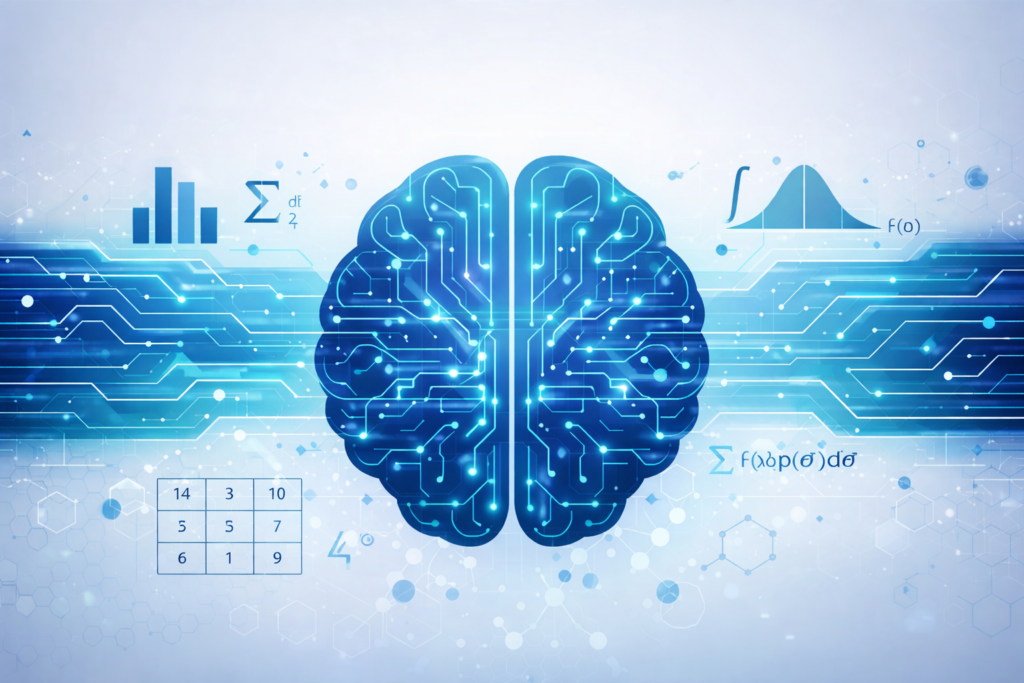
Artificial Intelligence (AI) often appears magical—machines recognizing faces, understanding speech, recommending content, and generating text or images. Behind this apparent magic lies a precise and powerful language: mathematics.
Mathematics is not just a supporting tool for AI; it is the core language through which intelligent systems are designed, trained, evaluated, and improved.
1. Why Mathematics Is the Language of AI
In AI-based projects, mathematics provides a structured way to represent data, define relationships, optimize decisions, and reason under uncertainty. Concepts such as vectors, functions, probabilities, and optimization techniques allow machines to learn and make decisions.2. Mathematics as a Universal Representation Tool
2.1 Why Representation Matters
- An image becomes a matrix of pixel values
- A sentence becomes numerical embeddings
- User behavior becomes feature vectors
2.2 Abstraction and Generalization
Mathematics enables AI systems to learn patterns rather than memorize data, allowing them to generalize to unseen cases.3. Linear Algebra: The Backbone of AI
3.1 Vectors and Matrices
Linear algebra underpins almost all AI systems:- Vectors represent features
- Matrices represent datasets and neural network weights
3.2 High-Dimensional Spaces
AI models operate in high-dimensional vector spaces, making dimensionality understanding essential for feature selection and reduction.4. Calculus: Learning Through Optimization
AI models learn by minimizing error using calculus-based optimization techniques.- Derivatives and gradients guide learning
- Backpropagation enables neural networks
- Gradient descent optimizes parameters
5. Probability Theory: Handling Uncertainty
Real-world data is noisy and uncertain. Probability theory helps AI reason under uncertainty.- Gaussian distributions model noise
- Bernoulli distributions support classification
- Bayesian inference updates beliefs
6. Statistics: Learning from Data
Statistics helps summarize, evaluate, and validate AI models.- Mean, variance, correlation
- Accuracy, precision, recall, F1-score
7. Information Theory
Entropy and cross-entropy measure uncertainty and prediction quality in AI models.8. Discrete Mathematics and Logic
- Graph theory powers recommendation systems
- Logic supports rule-based AI
- Combinatorics helps analyze search complexity
9. Geometry and Topology
Geometry helps AI understand distance, similarity, and structure—especially in computer vision.10. Mathematical Modeling in AI Projects
AI development translates real-world problems into mathematical formulations, refined iteratively.11. Trade-offs in Real-World AI
- Accuracy vs complexity
- Interpretability vs performance
- Scalability vs efficiency